Only to leave and to come back. Your Pass is for travelling abroad, so in your home country you can only use it for:
- one outbound journey, to leave your home country, and
- one inbound journey, to come back home.
For example, if you live in Germany, you can use your Pass to travel from your home town to the border at the start of your trip, and from the border back home at the end. You cannot use it to travel between German cities during your trip.
What are outbound and inbound journeys?
- Outbound journey: from anywhere in your home country to the border, an airport or a port.
- Inbound journey: from the border, an airport or a port back to anywhere in your home country.
Each of these journeys uses one of your 7 Travel Days. They are not extra Travel Days.
You can take more than one train for each journey, as long as you travel on the same day. Night trains work a bit differently. Learn how night trains work.
You don’t have to use your outbound and inbound journeys. If you want to start your trip in another country, you can get there another way and start using your Travel Days from there.
Need to travel more in your home country? You can buy extra train tickets from your national rail company. These costs are not covered by DiscoverEU.
How do I add an outbound or inbound journey?
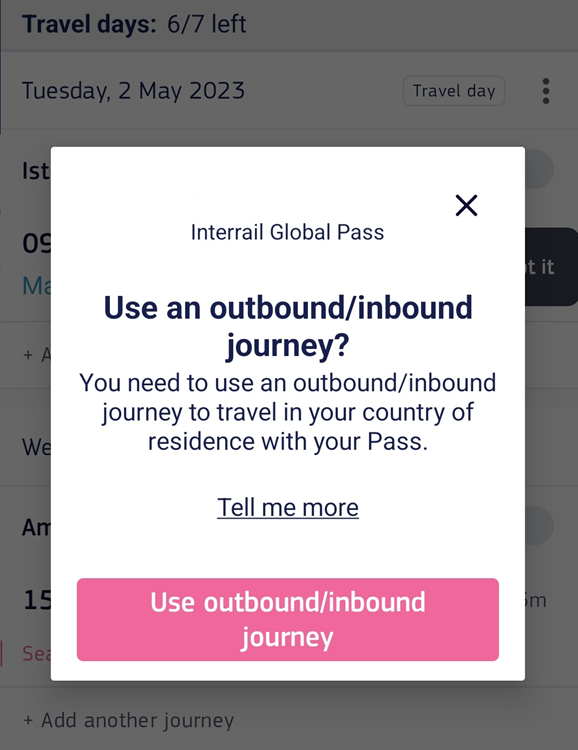
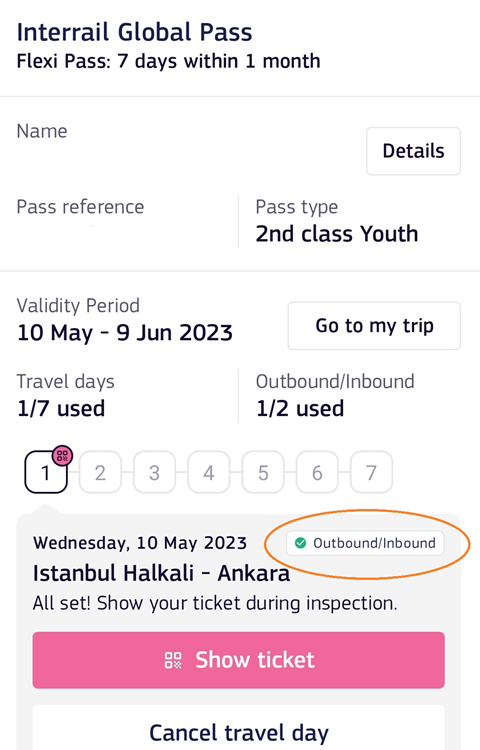
When you add a train journey in your home country to your Pass, the app will ask if you want to use your outbound or inbound journey. After you add it, the journey shows an “Out/In” badge in your Trip, and your ticket for that day shows that you’ve used it.
You need an internet connection to add these journeys to your Pass. After that, you can travel offline. Just remember to connect at least once every 24 hours to keep your Pass active.
What is my country of residence?
Your country of residence is the country you live in. It’s the country you confirmed when you booked your Pass. You can see it in the My Pass section of the app.
If you think your country of residence is wrong, please contact the DiscoverEU Travel Team as soon as possible.
What documents do I need to bring?
Train staff can check that you are a citizen or resident of your country of residence, so always bring the right document with you.
If you’re a citizen of the country: bring a valid passport or ID card. A driving licence is not accepted.
If you live in the country but are not a citizen: bring official proof of residence from the government, such as a residence card. It must:
- be issued by the government
- be valid for your whole trip
- have an official stamp or mark
- clearly show the country that issued it
- clearly show your name
The Spanish NIE is also accepted. Bills, rental contracts, bank statements, travel visas and the residence field in a passport are not accepted.
Travelling outside the Schengen area? Some countries, such as the United Kingdom, may ask for a passport and/or a visa to enter. Check the entry requirements early so you have time to prepare.